A complete POIS / ESAM server you can actually run.
A lightweight, self-contained Rust server for Program Opportunity Information Service (POIS) and ESAM workflows: a REST/JSON API, a web UI, and SQLite persistence for channels, rules, and ESAM event logs. It is also where SESAME lives in practice, the working implementation the protocol and its conformance vectors were extracted from.
Define channels, attach priority-ordered conditioning rules, and watch ESAM signals resolve against them in real time. The whole control surface ships in the binary, served from the server itself.
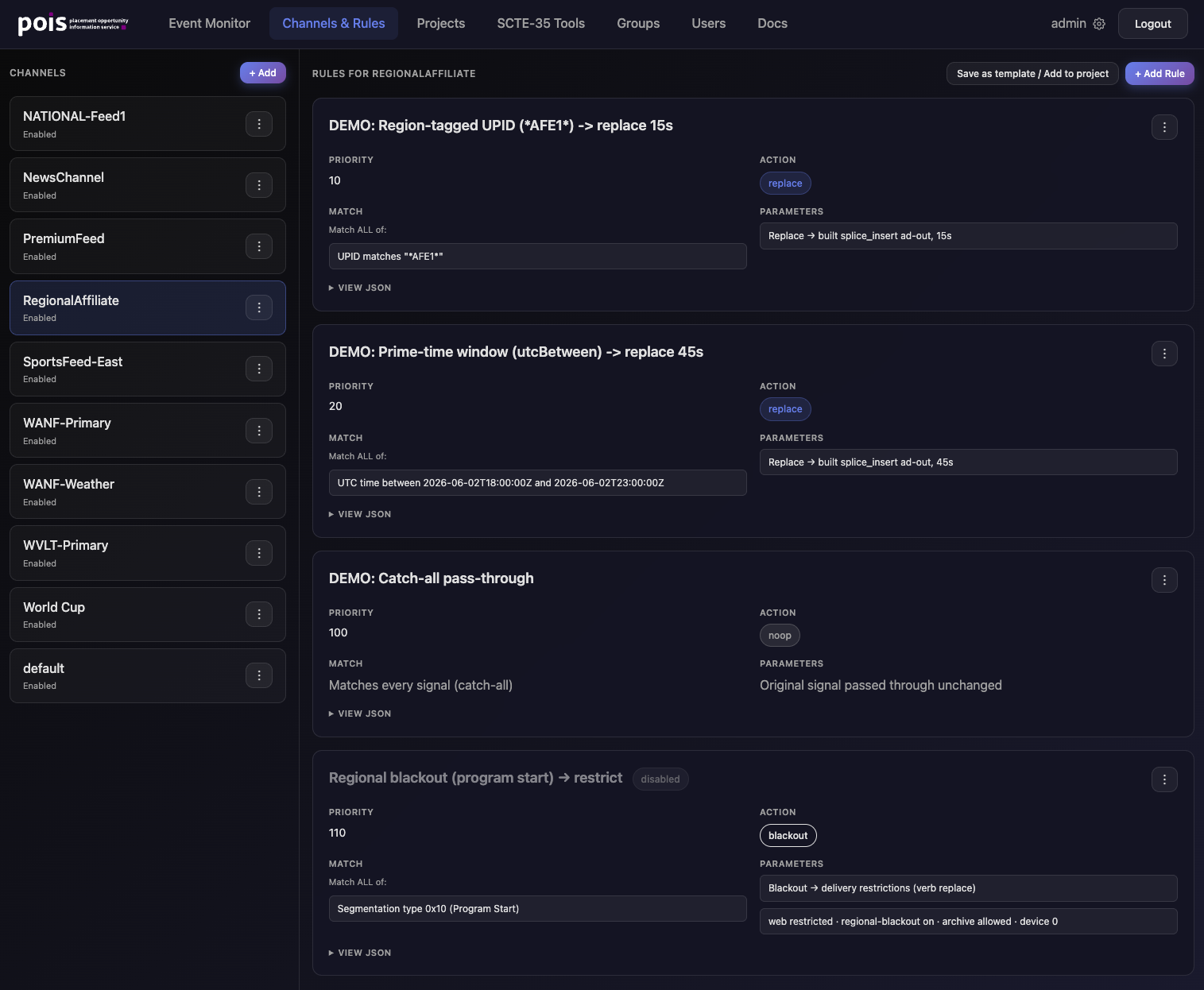
Channels & Rules: per-channel, priority-ordered conditioning rules with match conditions, actions, and parameters.
Everything needed to receive ESAM, decide policy, and prove what happened, in one binary you control.
Per-channel, priority-ordered rules with match conditions and conditioning actions. A default channel and a noop rule are seeded on first start, so the box is useful out of the box.
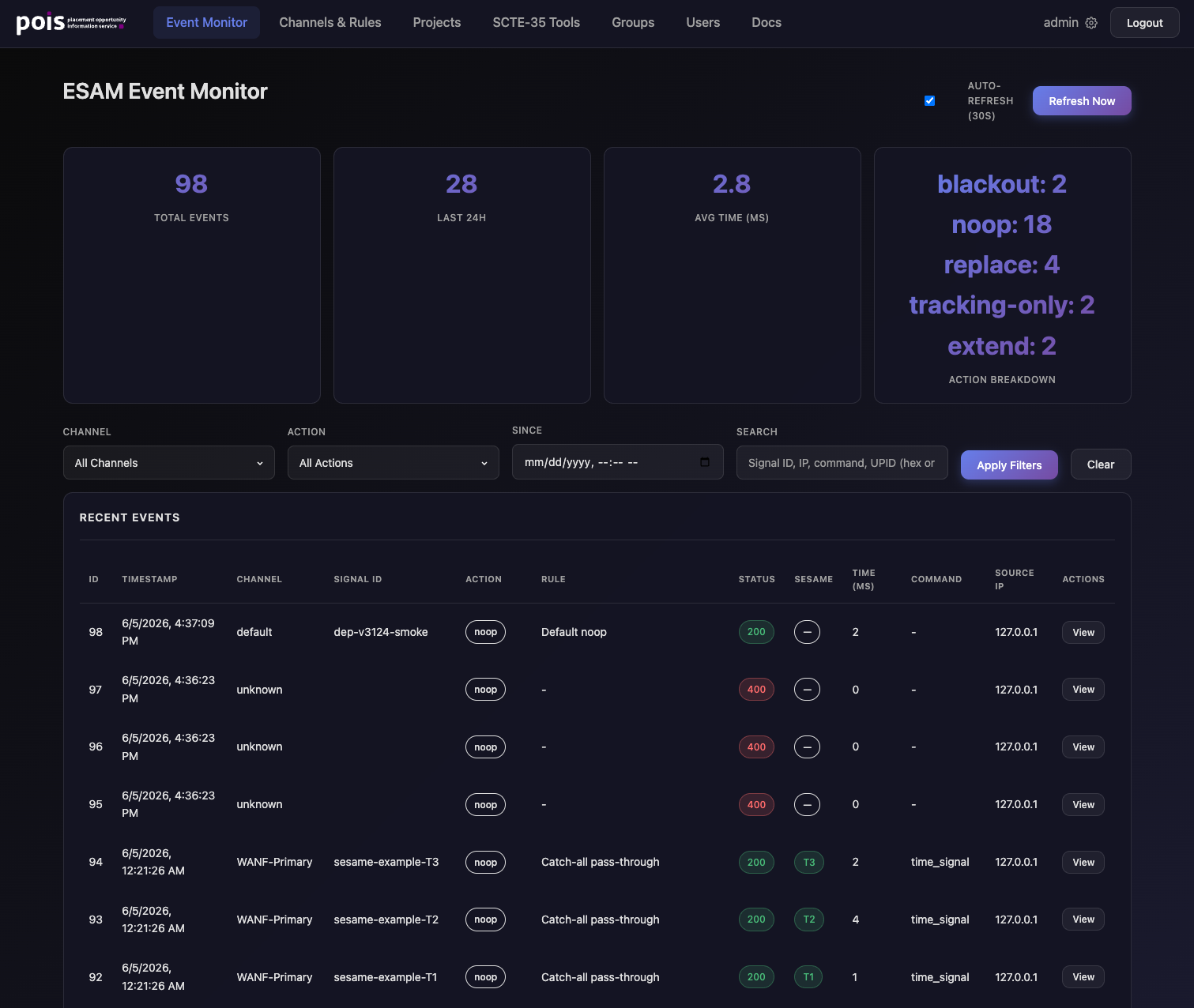
Live ESAM event logging and monitoring. Every signal that arrives is recorded with the rule it matched and the action taken, so the decision history is auditable.
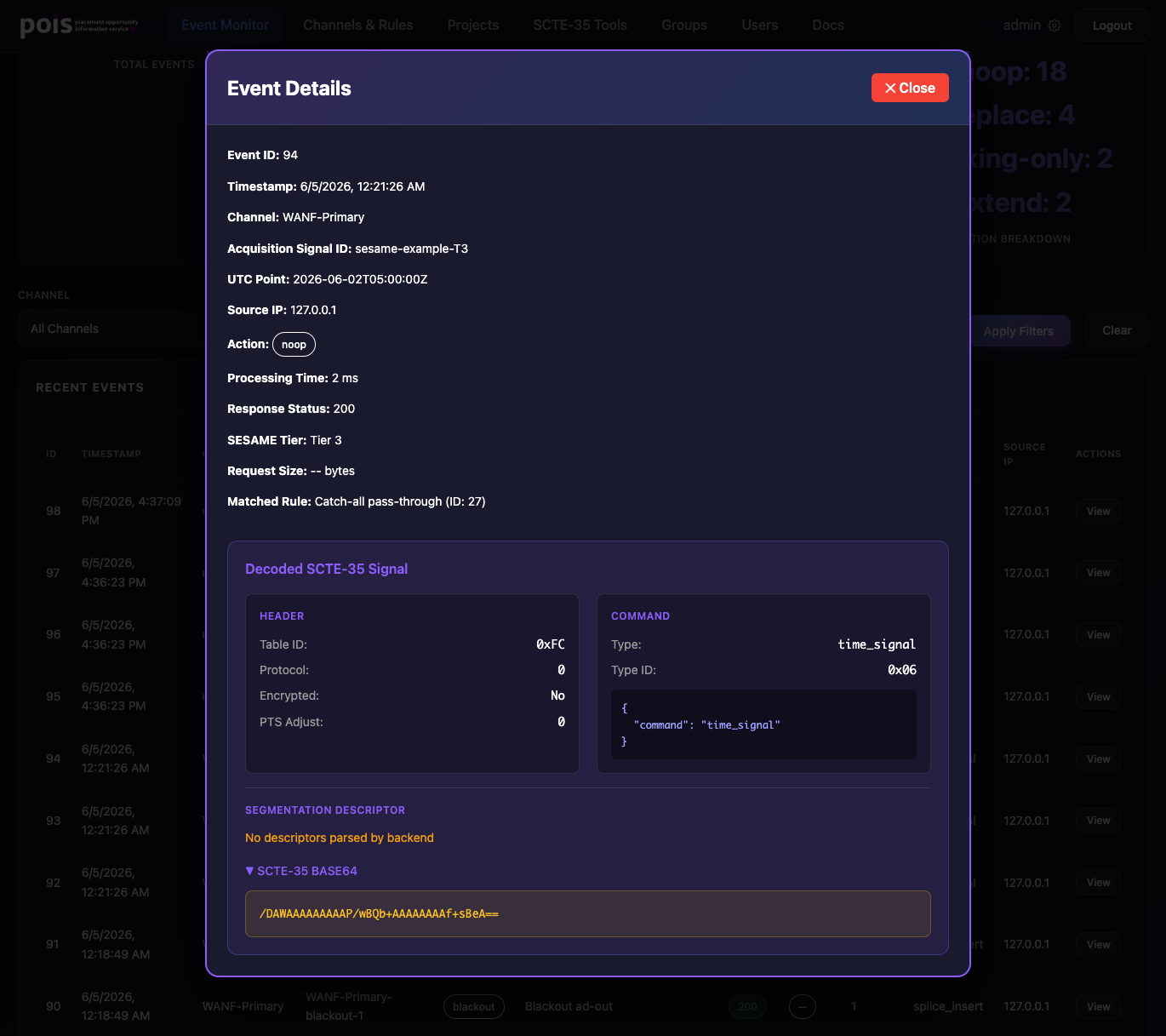
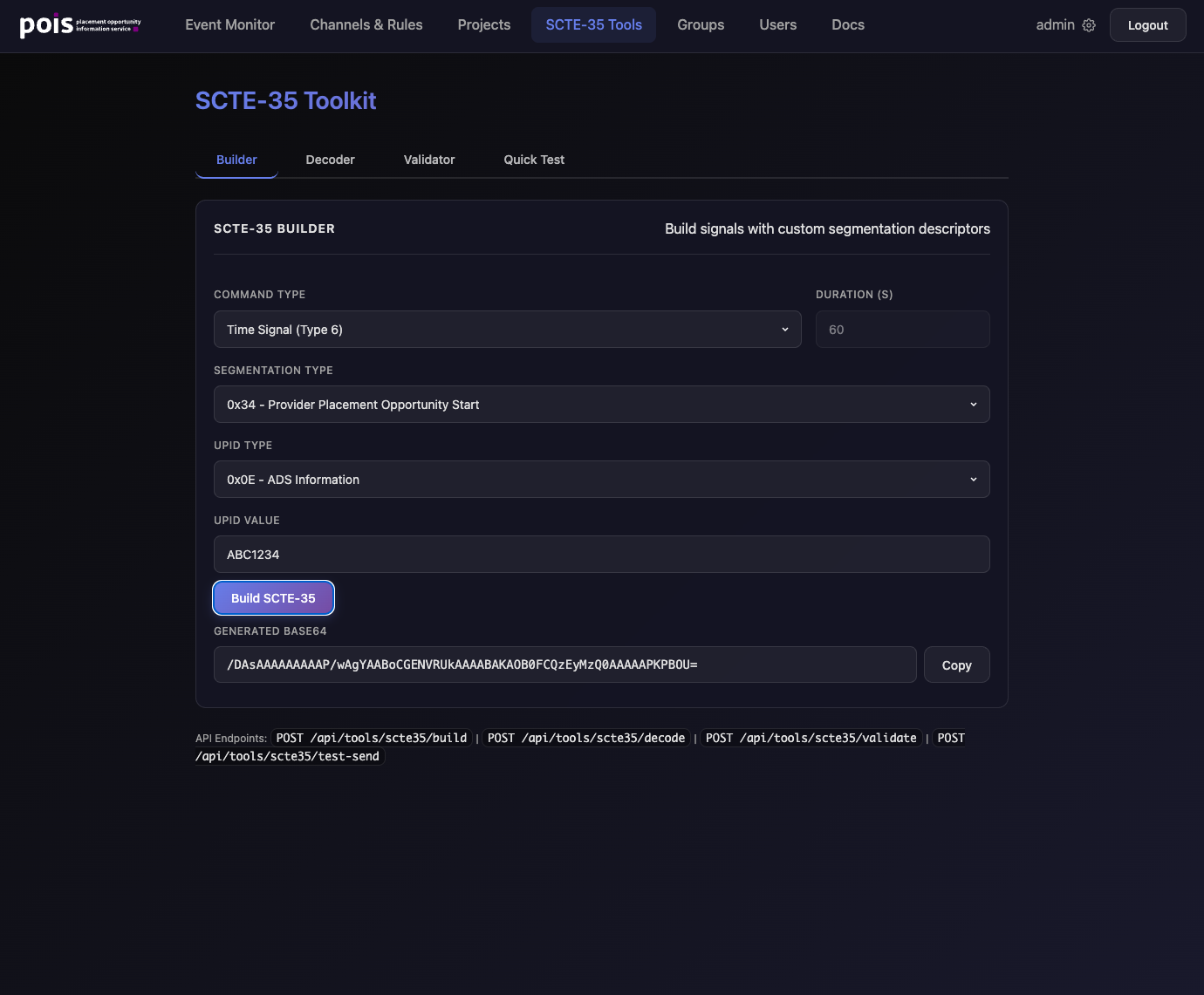
Build, decode, and validate SCTE-35 in the browser. The decoder accepts base64, hex, or binary input and breaks the message down field by field.
All three SESAME tiers wired straight through the ESAM path, verifying inbound requests and signing outbound responses. See the protocol →
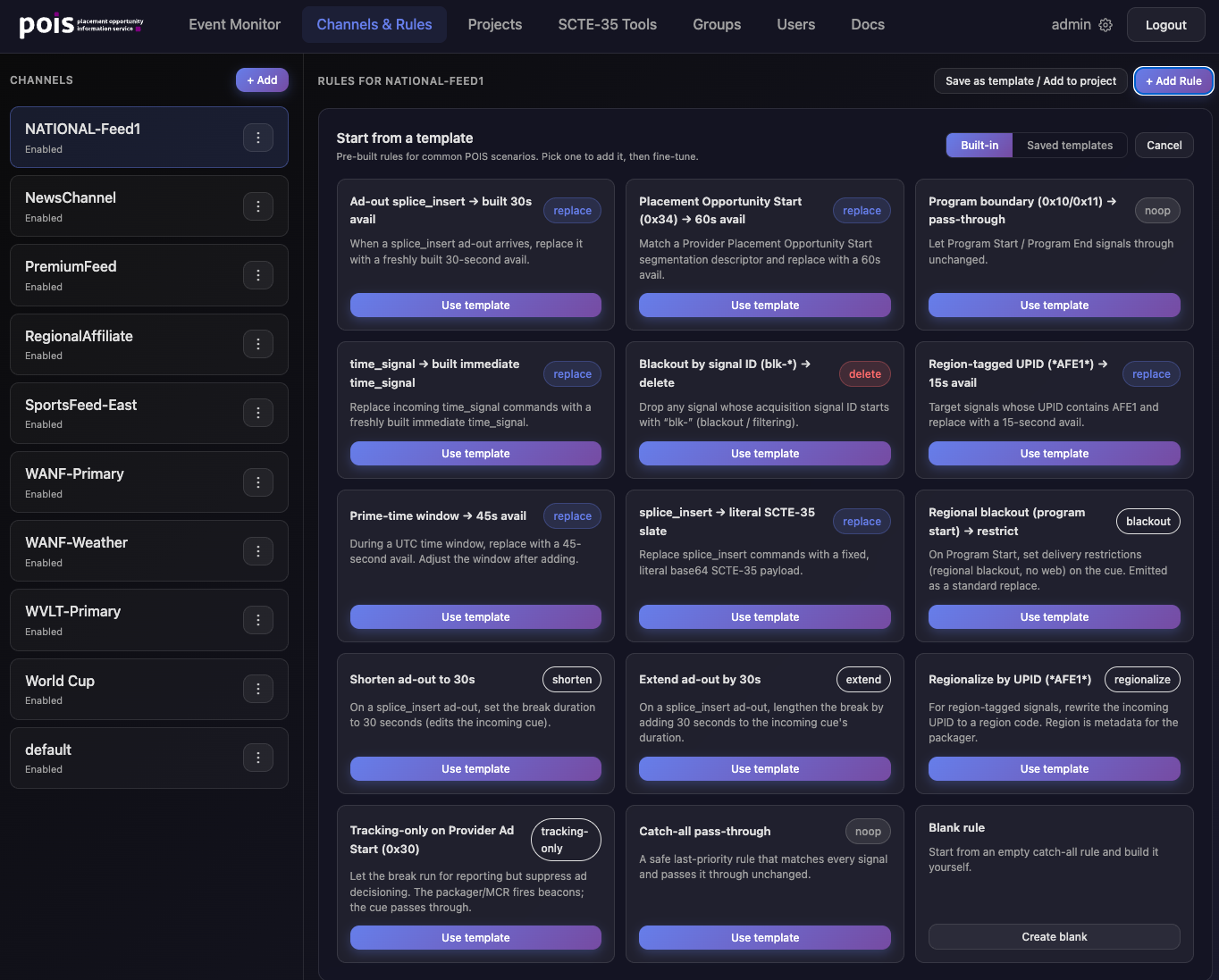
Save a rule as a template and group rules into projects, so a working policy on one channel can be reused and rolled out across feeds instead of rebuilt by hand.
User accounts, groups, and role-based access over a bearer-authenticated management API, so operators and integrations get only the scope they need.
Channels, rules, and events persist in a single SQLite file. Schema migrations run automatically on first start. No database server to stand up.
One-shot install on Ubuntu 24.04 (builds from source, sets up a systemd unit). Optional TLS via POIS_TLS_CERT / POIS_TLS_KEY. Zero dependencies beyond SQLite and Rust.
Everything in the UI is an API call. Manage channels, rules, projects, and users programmatically, or drive the ESAM endpoint directly from an encoder, packager, or SAS.
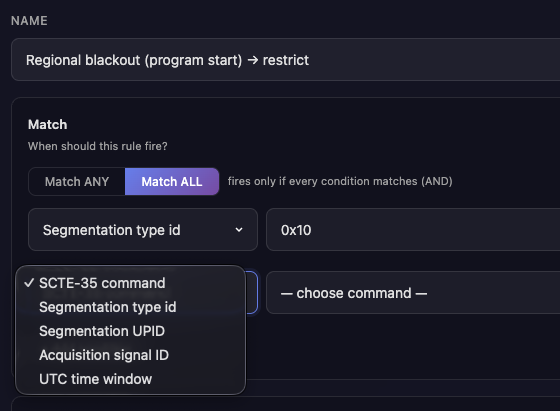
Each channel holds an ordered list of rules. A signal is evaluated in priority order; the first match wins. Rules match on UPID, time window, or SCTE-35 segmentation type, and resolve to a conditioning action with explicit parameters. These four ship as a demonstration policy on RegionalAffiliate.
Every rule is inspectable. Each card exposes the exact JSON it evaluates and emits, so a policy decision is never a black box: you can see the match it fired on and the SCTE-35 it produced.
The same server that conditions your signals also carries a full SCTE-35 workbench, so you can build a cue to test a rule, paste a capture to see what an encoder actually sent, or validate a message before it ships.
Compose splice_insert and time_signal messages from fields and emit the encoded form, the same construction the rules engine uses for ad-outs.
Paste base64, hex, or raw binary and get a field-by-field breakdown: splice command, segmentation descriptors, UPIDs, and durations.
Check a message for structural correctness before it reaches air, so malformed cues are caught at authoring time rather than in the field.
SESAME was extracted byte-for-byte from rust-pois, and the published conformance vectors are generated from it. Turning security on is a matter of configuration, not a rebuild.
Leave the SESAME variables unset and rust-pois is a clean Tier-0 POIS. Set a key directory and it verifies and signs.
The installer pulls Rust, builds the binary from source, and registers a systemd service. Allow a couple of minutes for the first build.
$ git clone https://github.com/bokelleher/rust-pois.git $ cd rust-pois $ sudo ./install.sh # prompts for service user + port # check it is running, then open the UI $ sudo systemctl status pois $ curl http://localhost:8080/healthz # visit http://<server-ip>:8080/
Prefer a throwaway dev instance? make run-dev starts a server on localhost:18080 against a separate database. Configuration is environment-driven: POIS_PORT, POIS_DB, POIS_TLS_CERT / POIS_TLS_KEY, and the POIS_SESAME_* family.
Clone it, install it, and condition your first signal. The protocol it implements is documented and open too.